Slice of Life Challenge Day 14 #sol18

A little ditty about reading and my father…

I’ve come to believe that the act of reading is an extremely personal act.

Which is fascinating.

After all, the process is fairly straightforward.  Step one: Focus eyes on printed words.  Step two: Decode words, either silently or aloud.  Step three:  Understand words.

And yet, consider the vast multitude of variables here; say, for example, you and I decided to read the same two-page text on, say, the topic of homework.  Likely, we might begin similarly, but not necessarily.  I might cast about for a stack of post-its and a pen, while you might just grab a pencil.  Or, you might do neither of those things.  Let’s move to the reading, the actual decoding part.  Immediately, I would venture to guess, a meaning-making process would begin in both of our minds.  I’m the kind of reader who struggles to read without confirmation bias; while you might be just reading to learn what the text is teaching; nope, no need to write anything down or gather evidence for a position for you– perhaps.  To really hang onto information, I must write something down.  Whereas you, you might not need to write anything down, or maybe you might struggle to care enough about learning the information to want to bother with all that.

Take my father recently.  Picture this:  He sips his Double Americano, seated in the “Stomping Grounds” coffee shop the other day. He leans over and pulls a book from his soft briefcase.  He sees me watching him.  “I’m reading this a third time,” he matter-of-factly informs me with his trademark serious tone.  Here’s what the first few pages of his book look like (he is a lifetime theological scholar):

That’s how he reads.  Always has. The annotations scrawled around the edges of each page resemble the precision of horned owl tracks after an ink-soaking.

Sitting across my father and pondering this sight, I recalled a question my mother-in-law asked me one time: “Isn’t comprehension just reading the words and understanding them?” she asked.  Well, yes.  But I think about things like, what kind of background knowledge do we interface with while reading? What kind of experiences come to bear on our meaning-making process?  What ideas do we grow as we read? What ideas is he growing?

My father never got a B in college.  Straight A’s.  Eight uninterrupted years.  Which is phenomenal.   His reading process might fascinate me more than anyone’s.

slice-of-life_individual


Slice of Life Challenge Day 13 #sol18

I saw my father this weekend…

I rang the doorbell.  Inside emanated the familiar barking sounds of an old basset hound, the lock on the door slowly unlatching.  Setting down my worn green suitcase, I straightened up.  Waiting. The door opened.

“Oh, there he is! Hello, son!”  Onto the slate tile floor inside the house, I stepped inside to embrace my father, my father who lives in Portland, Oregon.

“Hi, Pop, how are you?” I gently whispered into his right ear.  As he held me close to him, I detected a slight choking up in his throat as he uttered words about being glad I was there, it had been so long. I smelled the familiar cologne on his neck, and I suddenly thought back to those many times when I was a boy asking my father through a smile, “Dad, did you have a peanut butter sandwich today?”  Because I could smell the peanut butter.  He would just laugh and say, “Well, Mom might have fixed me one.”  Always a scent with my father. Always a smell- grass, cologne, the dogs, gasoline…peanut butter.

Standing embraced with my father, I closed my eyes, realizing I was still working to get used to this new reality.  No, my mom would not be turning the corner to greet me, would not be bustling down the tiled hallway to hug me.  We were alone.

Dad and I stood in a father-son embrace that seem to hang, suspended in time.  “I know Dad, it’s been a long time.”

slice-of-life_individual


Slice of Life Challenge Day 12 #sol18

A short but sweet vignette of a beautiful scene from the weekend.

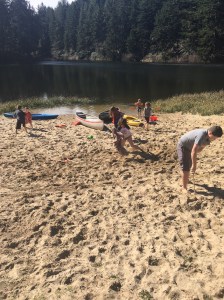
The sun shone down as eight cousins chased each other through the sand, scooped water in shoveled holes, piling onto one another in playful glee.  A rare sight, an unusual and beautiful scene.  My daughters- all three of them – soaking up time with their cousins.

I stood and watched. Smiling.

IMG_2764


Slice of Life Challenge Day 11 #sol18

We all have ideas, right? What if we believed in ourselves? Tried them out? Went for it?

“Can I ask you a question?” My colleague and I had just finished up a conversation about a student, and I looked up to discover lunchtime had arrived. Slightly unnerved, I silently wondered where our conversation was headed. Her tone exuded marked seriousness, and I immediately discerned that our upcoming exchange would involve a topic outside the realm of our normal work together. It’s funny how working with someone over the years can aid in developing a more acute listening.

“Of course,” I responded.

“Well,” she began, “you know how you’re always encouraging me to write? Like, start my own blog and stuff like that?”

I absolutely remembered. In fact, just this last fall I recalled discussing what topic or organizing concept she might start a blog around. But I knew she hadn’t started writing yet. At least, I didn’t think she had. “Yeah, I remember” I quipped.

“The truth is,” she continued, “I’ve been writing. I really haven’t told anyone here at work, but…I’ve got a story. It’s a book, actually.” She went on to describe a little of her inspiration for the book and a few of the issues her book addresses. As she spoke, I detected an uncertainty, a tenor of self-deprecation. It was familiar to me. Yes, this was in her nature, but I recognized it as part of mine as well. Creeping into her description of her writing and ideas seemed to be, for lack of a better term, doubt.

“That’s awesome!” I gushed. “But…what did you want to ask me?”

“Well, I know we are going to be hosting our guest author, Lynda Mulally Hunt, in just a few weeks. Do you think…”she paused. “Do you think I should…or could…do you think maybe I ought to ask her about her process? Like how she takes a story and gets it published?”

As you can imagine, I answered in the enthusiastic affirmative. “Absolutely you should?!” I answered. Because that’s what we need to do. We need to be there to encourage each other. To be a voice of belief for the unsure. To cheerlead one another’s ideas. Because who knows? Who knows where ideas might lead?

As my colleague exited my office that day, I thought about the fact that, well, we all have ideas, right? What if we believed in ourselves? Tried them out? Went for it? Found people who believed in us? Pushed past all the “reasonable” notions of why we can’t, shouldn’t, couldn’t. It’s that “reasonable” thinking that holds us back. Why not try unreasonable? Why not be unafraid to fail? How many times have I let that thinking hold me back? My loved ones? My students?

I hope my colleague pursues the publication of her book. I really do. And I also hope I can hang onto and spread this new resolve.

Because who knows where it might lead…

Slice of Life Challenge day 3 #sol18

As educators, we live in trying times. Answers are not black and white. How much do we shield our kids from darkness?

A Different Climate

Shuffling into the library media center, I lowered myself into a chair near the back.  Around me, I watched as my colleagues straggled in, weary from a long day of teaching.  Tension seemed to permeate our air, but it might have been just my interpretation.  Teachers huddled around the snack cart recently wheeled in, making small talk about the day.

Finally, after we had all settled into chairs, our principal began.  “Has anyone heard anything about the upcoming student walk-out?”  she asked. Our discussion that day pivoted in a direction that, I suppose was not completely unfamiliar, and yet it felt unfamiliar.  In light of the most recent school shooting tragedy in Parkland, Florida, what exactly is our role as educators? I listened as my colleagues shared their thoughts and ideas around ways we might support our students in the wake of yet another school-related tragedy.  Of course, this incident is one-of-too-many our nation has had to endure over the last nearly-twenty years.  And yet, in light of the recent mobilization and speaking out on the part of some of America’s student youth, something feels a bit different this time.

All of us agreed that, as educators, we would play no role in politicizing the issue.  We also agreed that although our students are middle schoolers, parents possessed every right to shield their sons and daughters from such a horrific “news story.”  And as I sat in my chair that day, I came to a realization I am sure many of us who work with students in educational settings have come to– we are living and teaching in a strange new era.  An era with no easy answers.  A time when grappling with unimaginable questions has become our reality.  Questions like, how much shielding should we do? How much darkness is appropriate to keep our students away from?  What level of acknowledgement is appropriate?  And when it comes to student-initiated action meant to call attention to a glaring national problem, how do we position ourselves as adults of influence?

Not surprisingly, this agenda item dominated our faculty meeting.  And while many positive ideas emerged from our discussion, resolution remained elusive.  Our principal thanked us for the thoughtful exchange of ideas, and everyone rose to leave.

But one idea had definitely risen and crystallized that afternoon.  One idea inarguably true.  One that contained not one bit of murkiness or question: We love our students.  And that is likely why all of us educate.  In this new strange time that has shaken many of us to our very core, loving our students has not changed.  Perhaps some comfort might be taken from just that.

slice-of-life_individual